Wikipedia

Search results

Sunday, 22 February 2015

Thursday, 19 February 2015

OOTD: It's What It's


Sunglasses: Forever 21
Necklace: Necklace Peace by Pevita Pearce
Watch: Guess 
Clutch: Palomino Collection 
Tanktop: Marks and Spencer 
Blazer: Zara 
Pants: BCBGenaration 
Heels: C&K


OOTD: Polkadot Mood


Lipstick: Max-Factor
Top & Pants: NN


Ditraktir #BLIBUR ke UK

Maaf ini agak basi post-nya, karena kemarin sempet kelupaan untuk kepost dan lagi final exam (Biasa anak kuliahan) hahaha. Tapi jangan sedih! there are tons of stories yang mau gue share pas ke UK alias UJUNG KULON! Check this out :>

BOOOMMM! 
Jadi ceritanya, kemarin-kemarin kakak Djalul (Mantan Kakak senior di Satucitra dulu) ngeinvite gue untuk datang ke launching beta blibur.com, then I attended lah. Nah pas lagi acaranya, ada ice breaker dan hadiahnya trip gratis dari blibur. Dan hadiahnya adalah liburan ke UJUNG KULON!

WHERE is it
Lokasi taman nasional Ujung Kulon berada di ujung barat pulau Jawa bagian selatan dan masih berada di provinsi Banten. Probably around 183 km or 8 hours from Jakarta.  During the journey menuju sumur, bus-nya kita sempet tenggelem setengah di lumpur dan it happened at 5am. Wat we did? cowok-cowok berusaha untuk mendorong dan kita cewek-cewek bantu goyang-goyang ngak jelas dari dalam mobil. #kebayangkan??!!!?? Around 6.30 am, some of people came and help us out. TEBAK! gue dimana dalam photo ini?

Jawabannya; gue di belakang mobil! ya di belakang mobil merah yang kecil itu! lagi makan pisang molen harga Rp 500.00! (dan gue beli 10.000 hohoho) bagi gue ini sebuah keajaiban menemukan  molen harga gopek! disaat-saat genting seperti ini hahahaha maaf lebai tapi taste good lah!


WHO:
Gue pegi bareng siapa?? bareng #BLIBUR team and their participants. Most of them are totally crazy people yang kegilaan-nya berpangkat kuadrat! apalagi yang namanya kakak IVAN! selalu bikin kita ketawa terbahak-bahak! hahahaha and I'm still questioning ya, who is the first called me; MS. BARBADOS!??

TOLONG PECAHKAN MYSTERY INI TEMAN PERJALANAN! 


Maaf kami terlahir dengan sense yang langkah 
"peka terhadap kamera" 


WHAT we did? 

1. Ngechill di pulau Peucang. 

Oh man! Berasa kita yang punya pulau, karena cuma kita yang stay hahahaha. 
Selama di pulau peucang, kita ditemani oleh babi utan yang montong (minta dipotong), rusa-rusa yang keep calm and eat grass dan monyet-monyet nakal yang ngerti mana makanan dan mana gadget (iphone fitrah nyaris ahaha)! Karena suasananya begini, gue berasa lagi di safari. tapi kok gue ngak nemu badak berculah satu yaa?!? 


2. Melihat lebih dekat banteng-banteng di pulau Cidaon. 


Selama disini, mata gue harus lihat kebawah terus karena banyak ranjau si banteng! But wait, gue masih rada binggung sih bedain; ini banteng atau kerbau? atau sama aja? (swear! gue ngak tau) 


3. Snorkling disekitaran peucang dan menelusuri sungai cigenter. 

Yang paling bikin deg-degan pas kita lagi ngendayung, bisa tetiba ada ombak besar dan sampan-nya kemasukan aer. So, kita harus ngegayung keluar airnya hahaha! dan ini terjadi di sampan gue dan the savior is YUKI (ini cewek) yang sudah susah payah ngegayung aer sambil ketawa dan panik hahaha.  


4. Lunch ditengah bangan nelayan. 

Ketika semuanya lagi ngantri makan siang, gue (yang diujung kanan pakai baju warna biru) lagi kepo dengan ikan hiu yang nelayan tangkap. ANW, lunch kali ini SUPER dan DAHSYAT enaknya, gue aja sekarang lagi typing down sambil ngembayangin ikan terinya + Nasi anget + Sayur Asem #ngiler  


.


FUN FACTS:
1. Ternyata Ujung Kulon merupakan edipermi malaria!
Jadi ceritanya, gue ngak tau kalau kita disarankan minum obat malaria sebelum pergi. Jadi ada malaikat yang berbaik hari mengingatkan; namanya YUKI (yang ini cowok) dan tanpa tak tau malu; gue langsung minta sama dia (padahal kita baru kenalan 30menit) hahaha

2. SEATMATE yang asik
Yeay! Gue punya temen ngobrol yang ngak membosankan selama perjalanan! namanya IYANG selama perjalanan kita cerita apapun dan sharing ipod; dan gue berhasil influenced him to like jessie ware! hehehe

3. DUNIA ITU SEMPIT
Pas menginjakan kaki di pulau peucang, Accidentally ketemu sama temen belitung gue; ANDREAS. Dia juga lagi trip ke UK sama temen-temen kampusnya.

3. BLIBUR CREW: FIFI, DJALUL, ACEL, EREL dan semuanya keren dan sangat berbaik hati mau memberikan trip gratis ini! (sering-sering dung! atau kita bikin khusus "JOMBLO TRIP" hahahahaha
To sum up my story, this was fun trip and memorable banget! Dari yang ngak kenal siapa-siapa jadi punya banyak teman. I wanna say TERIMAKASIH #BLIBUR dan SALAM KANGEN,


Dari Hannah Manuela untuk Teman Perjalanan
#ditraktirBLIBUR 

OOTD: RANDOM DAY, RANDOM OUTFIT


HAT: Berskha
TOP:Vornera
SUNGLASSES: Forever 21


I just had the most random and spontaneous trip this week with this crazy girl; SYSCA! We decided to go 1am and we left at 5am!
We didn't have any preparation, just asked to random people how to get there.
But We had so much fun at Tidung Island.
Went round by using bicycle, jump down from "Jembatan Cinta" twice, and end up with Pang Ping Pong Game with New Friends!

Keep my word! I'll back again and make another story!


OOTD: Warm Inside, Cool Outside


Tanktop: Topshop
Outer: H&M 
Skirt: Private Collection by Febby 
Sunglasses: Forever 21 
Bracelet: CK 

Thursday, 29 January 2015

Banjar People Towards to The Era of Globalization


 “Today in the era of globalization, there is no such issues as borders between states of the same nation” Fatos Nano

Kalimantan as the third-largest island in the world and the largest island in Indonesia, reach 5,6% of total Indonesia population. Kalimantan also contributes 8,31% of national Gross Domestic Product in second quarter of 2014[1] which is produced by potential sectors such as mining, forestry, agricultural, fishery, manufacturing, tourism, etc. This positive progress of economy gives a lot of opportunity to Kalimantan to improve. This progress also brings the globalization and social change to Kalimantan especially province capital city which developing their area like south Kalimantan.

The globalization effect and social change looks so significantly here in South Kalimantan, for example from the transportation aspect in Banjarmasin, almost every hour, there is flight to Banjarmasin and dominated by Garuda Indonesia. If take look from the passenger, mostly they are expatriate who work in mining industry. In any case, globalization also affects to society which is the presence of KFC in Banjarmasin, roughly every 3-5km, there is KFC store. It sounds interesting, because due to the fact Banjarmasin people are influence by expatriate culture that likes fast food.

If take look smaller scale or individually, globalization affects to a person characteristic, which is consumerism. Most of Banjarmasin people are in middle upper in social class. They spend their money by buying luxury car, invite famous diva to their married receptions; even though their live in sub urban area of south Kalimantan. This shows people have high level of consumerism, and I think it because they have good economy progress in their business and keep increasing. 


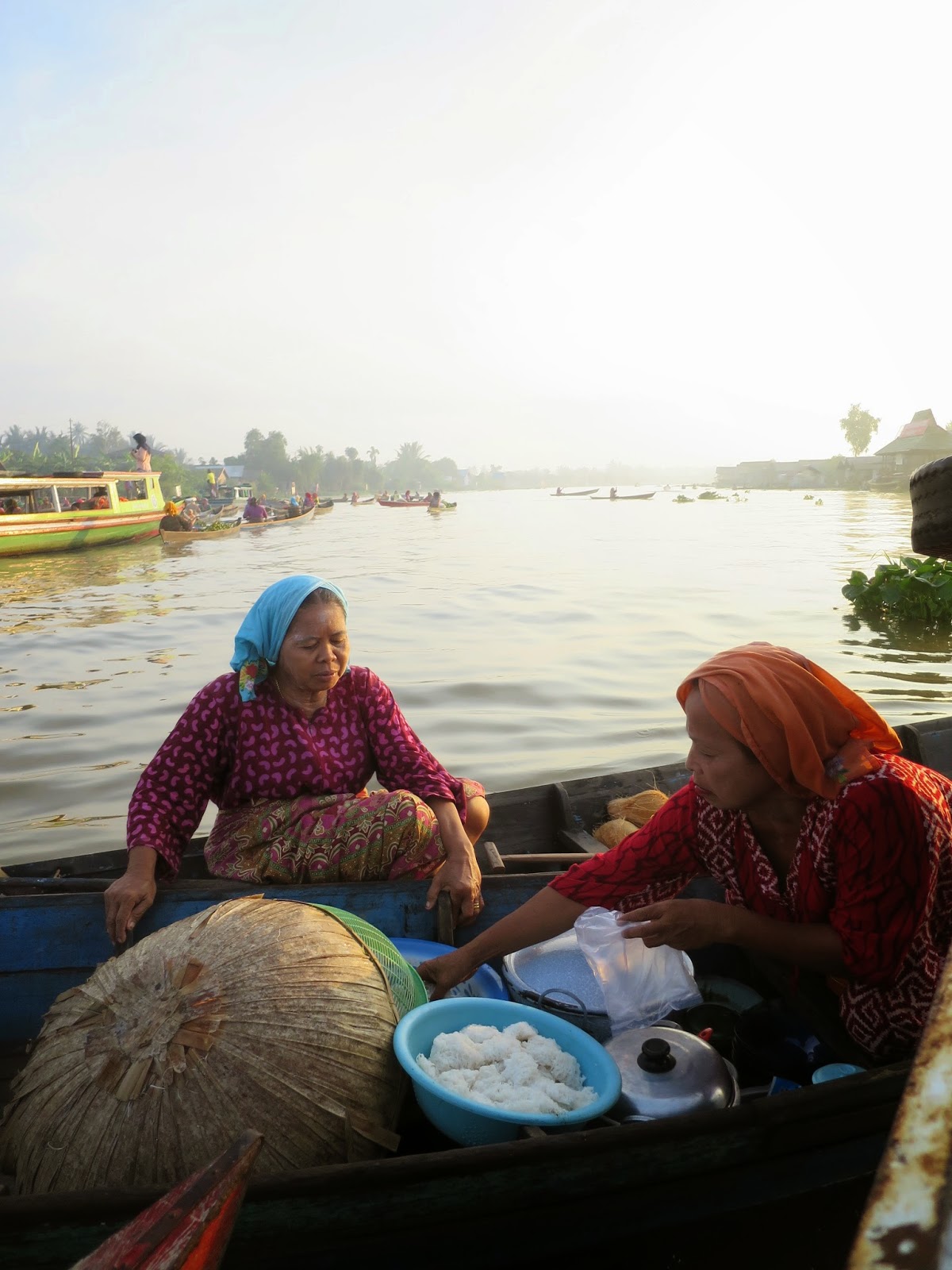
But unfortunately, the number of economy progress doesn’t same as the reality in riverside of south Kalimantan capital city. Lot of native Kalimantan especially Banjar people who live along Barito riverside still categorize as almost poor and poor; they live below in minimum living cost. Like this interviewee, that I met three weeks ago.


Since 30 years ago, this mid old women has been familiar with this jukung (boat in Banjar language) and Barito River. She asked by her parents to work on floating market, up until now she keeps doing it. She comes from assimilation ethnic between native Kalimantan: Dayak Ngaju and Melayu who already stereotyped as a trader. Before sunrise comes up, she paddles her jukung along to Barito River with her four years daughter. They go around floating market to do economy activities: sell and buy daily goods or even some of them still do barter or they call bapanduk, if the value of those things is same. She is not the only one who vends her goods here, but she does with others fortyish women; they do selling and buying on floating market as same as their forefather who do economy transaction as a part of their culture. 


Because of the uniqueness of floating market as product of culture and tradition, this floating market become one of top tourist destination in South Kalimantan, which have good potential in order to attract tourist. Throughout this opportunity, trader can sell their product to tourist directly and welcome the tourist warmly. In 2008, this floating market can reach 24.000 tourists but it doesn’t go well, one year later, the number decreased to 22.000 and until 2010 this tourism object only reach 19.000 tourist. [2] Currently, the presence of floating market so concerned, the cause of decrease number because the floating market does not crown as it was. The trader or women prefer to move to land market because there is opportunity get more income. And also because of the society has changes. In the past, people are using jukung or boat as their transportation to go from one point to another point but now the globalization brings the advancement of transportation. People tend to use motorcycle as their transportation because it more effective and efficient. Another reason is unequal region development; it means government only focus on land development not the floating market sector, which makes the trader force to move in order to survive.


Because of these issue, her income also decrease. She only can survive with Rp 10.000 – 15.000 every day. Because of this economy reason, she hasn’t given her daughter education; she prioritizes her son to school in order to help the family have better life. She sends her son to Islamic school, which free tuitions, than go to the government school and should pay Rp 10.000 per month.

Relate to the case, globalization is not only talking about how a region integrated to economy and socio aspect but also it tells about how the society works on development and changes, does the society ready enough to face the development or changes of economy and socio integration?

Globalization has powerful economic, cultural and social dimensions. According to world commission of ILO[3], the social dimension of globalization refers to the impact of globalization on the life and work of people, on their families, and their societies. Concerns and issues are often raised about the impact of globalization on employment like get the continuer of floating market trader, working conditions: Market is dominated by land market, income and social protection: the minimum of income. This Globalization dimensions probably contributes to the alienation of individuals from their traditions. They; Banjar people keep following the tradition which is being floating market trader but on the other hands, the society forces them to change to be trader in land market. If not, they will survive by themselves in the era of globalization. That’s why; this case is concluded as the combination of Sociocultural and economic globalization where these three things come as one big issue, which damage for Civilization of Banjar people in keep the tradition context.

 
Of course Globalization brings new potentials for development and wealth creation. But there are divergent views and perceptions among people as concerns its economic and social impact, and indeed widely varying impacts on the interests and opportunities of different sectors and economic and social actors. Globalization may allowed those poor region to increase their standards of living but it will cause massive dislocations of people as they move to find jobs in more prosperous region. There is also concern that local cultures will be lost as cross-fertilization and integration of cultures become more pronounced.

To understand these globalization effects, I apply a perspective from Global Transformations book[4]. The authors; David Held, Anthony McGrew, David Goldblatt and Jonathan Perraton describe three perspectives on globalization which are Hyperglobalist perspective,
 Skeptical perspective,
and  Transformationalist perspective. And the most suitable perspective to this case is Transformationalist perspective. First, this perspective states that there is no single cause behind globalization. It means there are many possibilities that brings globalization to South Kalimantan like; expatriate’s lifestyle, education, government policies, economic logic and etc. secondly, this perspective assume the outcome of processes of globalization is not determined. People can’t hide or deny what outcome of globalization; it might be positive and negative, both are the consequence of doing globalization. It sounds negative if government forcedly to focus on land market development, it doesn’t mean floating market is totally end but it can be good start to improve floating market in tourism sectors. Remember people can’t determine the outcome but at least control and direct it to be positive outcomes.


Transformationalist authors believe that the same general changes have occurred from globalization but there is no direct belief in the exact direction that these changes came about. Transformationalist say the power of national governments is increasing but the nature of these national governments is changing. This perspective believes that the range of factors influencing processes of globalization is much greater, and the outcomes of globalization are very uncertain
It’s important to realize that globalization occurs in Banjar people actually it’s era where people are entering a new civilization. Where they should be open to change. But they need socialization that helps them understand and diminish the miss-interpretation of globalization effects.

I concern to those traders who surviving below twenty thousand rupiah, I think just give them a opportunity to they to be open to the social change and they will follow the globalization in good way. Personally, I agree if globalization occurs in Banjar people life, because they can improve their life better; they can get better job, better transportation (boat with machine) better education for their children, better future. They just need a process where they can adapt their culture with the change. As recommendation Governments need to prepare formulation of policies that help the economic activity between regions and build the skills of Banjar people to prepare them for entering the global market. But if not, the government will face extreme social gap between the rich and the poor or it will end as inequality prosperity.

Love, 

Hannah Manuela 
Banjarmasin - November 2014 
for Social Change and Globalisation Mid Exam 


[1] http://www.bps.go.id/brs_file/pdb_05agus14.pdf
[2] http://id.wikipedia.org/wiki/Pasar_terapung
[3] http://www.ilo.org/public/english/wcsdg/globali/globali.htm
[4] Held, David, Anthony McGrew, David Goldblatt, and Jonathan Perraton. 1999. Global Transformations: Politics, Economics and Culture. Stanford: Stanford University Press. Introduction, pp. 32-86.